What 'Commercial Concrete' Actually Covers, and Why It's a Different Discipline
The same material, a completely different set of engineering demands.
September 15, 2026 · 3 min read
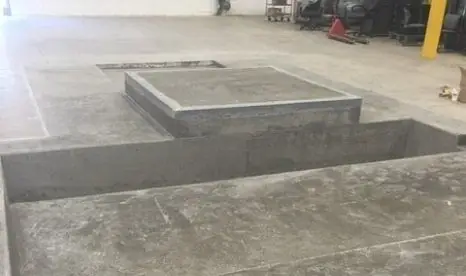
It Starts With Load, Not Looks
Residential concrete and commercial concrete use the same basic material, but the engineering behind them isn't the same conversation. A driveway is built to carry cars. A loading dock, a machine foundation, or a heavy-duty warehouse floor is built to carry forklifts, industrial equipment, pallet racking loaded to capacity, and constant point loads landing in the same spots day after day. That difference in how the concrete will actually be used changes almost everything about how the job gets planned, formed, and poured.
Who This Kind of Work Is Actually For
Commercial and industrial concrete work covers a wide range of clients, from a manufacturing facility that needs a machine foundation for new equipment, to a distribution center adding loading docks, to a retail property that just needs its parking lot repaired before another Chicago winter takes it further apart. What connects all of it is that the work is planned around continuous, heavy, repeated use rather than the occasional weight of a car pulling into a driveway, and that changes the reinforcement, the base preparation, and the finishing decisions from the ground up.
Machine Foundations and Loading Docks
A machine foundation has to do a great deal more than sit still. It has to isolate vibration, hold precise tolerances so equipment stays aligned, and support concentrated weight that behaves completely differently from a spread-out live load like foot traffic. Loading docks add their own demands, with the constant impact of trucks backing in, dock plates, and repeated heavy loading and unloading wearing on the same few square feet of slab. Carl Johanson & Son Construction Co. Inc. builds both as part of its commercial and industrial work across Chicago and the North Shore.
Heavy-Duty Floors and Parking Lots
A heavy-duty floor inside a warehouse or industrial building has to handle equipment traffic without cracking, spalling or wearing down at the seams over years of use. Concrete parking lots carry a different combination of stresses, vehicle weight and turning traffic across a large open area, combined with the same freeze-thaw and road salt exposure that wears on residential driveways, just at a much larger scale. Getting the base preparation, jointing and reinforcement right on a project this size matters more, not less, because there's so much more slab for a mistake to show up across.
Ramps, Additions and Excavation Work
Handicap ramps have their own requirements around grade and surface, since they're built specifically to be usable, not just present. Additions and excavation work often come before any of the above, since commercial and industrial sites frequently need grading, excavation and even concrete breaking to remove old flatwork or foundations before new work can go in. It's a full scope side of the business, not an add on to residential work, and it's handled by the same company rather than subcontracted out.
Why Scheduling and Sequencing Matter More Here
A commercial job usually isn't happening in isolation. A loading dock pour affects when trucks can use a facility, a warehouse floor section closes off part of an operating building, and a parking lot repour has to account for employee and customer access the whole time the work is underway. Sequencing the job so that excavation, forming, the pour, and curing happen in an order that keeps as much of the property usable as possible is its own skill, separate from the concrete work itself, and it's usually the difference between a commercial client who's mildly inconvenienced and one whose operation is genuinely disrupted.
Concrete breaking and removal ahead of a new pour also has to be planned around what's staying in use nearby, whether that's an active dock door, a section of parking lot customers still need, or utilities running underneath the area being replaced. On an industrial or commercial site, what happens before the pour often takes as much planning as the pour itself.
A Company Built for This Scale of Work
Carl Johanson & Son Construction Co. Inc. has done commercial and industrial concrete work across Chicagoland since the business was incorporated in 1967, building on a family concrete business that goes back to 1909. Carl Johanson III, who joined the company in 1985, runs it today as owner and president. The company holds a City of Chicago Masons License and a City of Chicago CDOT License, is licensed throughout the North Shore suburbs it serves, bonded, insured, and carries an A+ rating with the BBB. Estimates are free. For a machine foundation, loading dock, heavy-duty floor, parking lot, ramp or excavation, call (847) 933-1709.
Carl Johanson & Son Construction Co. Inc., (847) 933-1709
Call (847) 933-1709More articles
Cracked Driveway? How to Tell If It Needs Repair or a Full Replacement
Not every crack means a new driveway. Here's how to read what your concrete is actually telling you.
What a Concrete Job Actually Looks Like, From the First Walk to the Final Finish
A walkthrough of what actually happens between calling a concrete contractor and getting your property back.